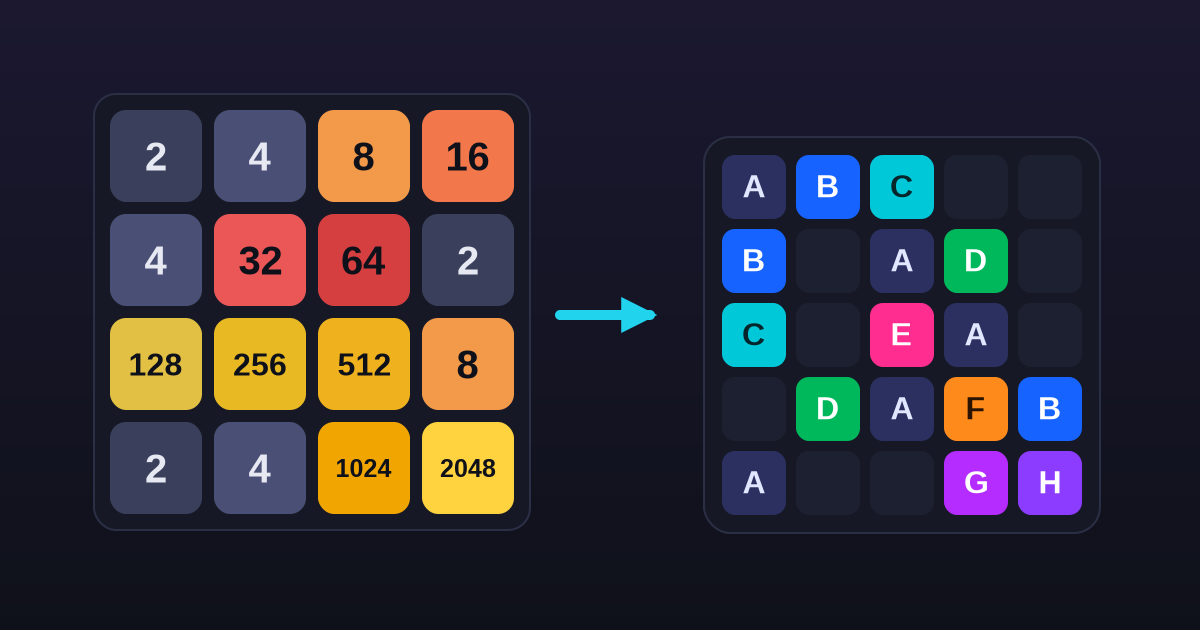
Quick answer: If you love 2048, look for other merge puzzles: games where matching tiles combine into a bigger one and the challenge is managing space and planning ahead. Merge games differ mainly in how you merge: by sliding the whole board, pulling matches to one tile, or dragging one piece onto another. Good next steps include number sliders like Threes!, match-and-build games like Triple Town, drop puzzles like Drop7, and letter merge puzzles like PULL, which swaps swiping for tapping and adds a daily challenge.
2048 is one of the most played puzzle games ever made. If you've reached the 2048 tile (or come close and lost it), you've probably wondered what to play next. This guide explains what makes 2048 work, the families of games that share its appeal, and what to look for when choosing one.
What is 2048, and where did it come from?
2048 is a sliding-tile puzzle on a 4×4 grid. You swipe up, down, left or right; every tile slides as far as it can, and two tiles with the same number merge into their sum. After each move a new tile appears, usually a 2 and sometimes a 4. The goal is to build a single tile worth 2048 before the board fills up.
The game was released in March 2014 by Italian developer Gabriele Cirulli, who made it over a weekend and published it free and open source. In its own credits it says it was based on an earlier game called 1024 and is conceptually similar to Threes!, a sliding-number puzzle by Asher Vollmer and Greg Wohlwend released a few weeks earlier. Because 2048 was open source, thousands of variations followed, from bigger boards to themed tiles.
What is a merge puzzle, and how is it different from match-3?
In a merge puzzle, identical pieces combine to make a better piece. Two small pieces become one bigger one, two of those become a bigger one still, and so on up a ladder of levels.
That's different from match-3 games such as Bejeweled, where lining up three matching pieces clears them from the board. In a merge game, matching pieces don't disappear: they combine and move you up the ladder. Match-3 games are about clearing; merge games are about building.
Why are merge puzzles so satisfying?
Merge puzzles combine a few ideas that our brains find very rewarding:
- A clear ladder. Every merge doubles the value, so progress is easy to see. Each step up the ladder takes twice as much work as the last.
- Planning under pressure. Every move adds a new tile, so space is always shrinking. Good play means thinking a few moves ahead.
- Chain reactions. One well-planned move can set off several merges at once, which feels great.
- "One more go." A game lasts minutes, and a near miss makes you want to try again straight away.
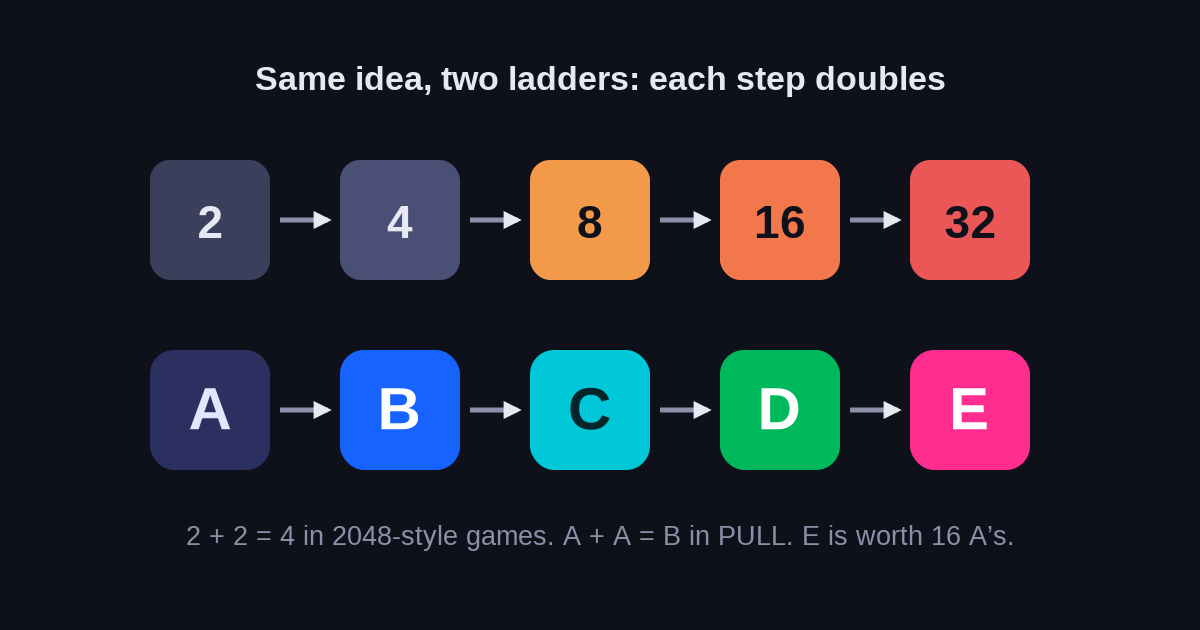
Because each level doubles, each step takes twice as much work as the last. A 2048 tile takes 1,024 twos' worth of merging. In PULL, an E takes 16 A's, and a Z takes over 33 million A's' worth.
What makes a merge puzzle challenging?
- Space. Most merge puzzles add a new piece every move, so the board keeps filling up. Merges create space; everything else uses it.
- The next piece. Where and what the next piece will be changes everything. Games that show it in advance, like PULL's dashed square or the hint in Threes!, reward planning over luck.
- Chains and combos. The most satisfying moves set off several merges at once.
- Blockers. Pieces that don't match get in the way. Working around them is the heart of the strategy.
What should you look for in a game like 2048?
| Feature | Why it matters |
|---|---|
| Simple rules, deep strategy | You can start in seconds but keep improving for months |
| A visible next tile | Lets you plan rather than rely on luck |
| Combos or chain reactions | Rewards setting up moves in advance |
| Readable tiles | Large, high-contrast tiles are easier on the eyes |
| A daily challenge | A fresh, shared puzzle that's comparable with friends |
| Fair monetisation | No pay-to-win or constant interruptions |
What kinds of games are like 2048?
Merge games handle merging in three main ways:
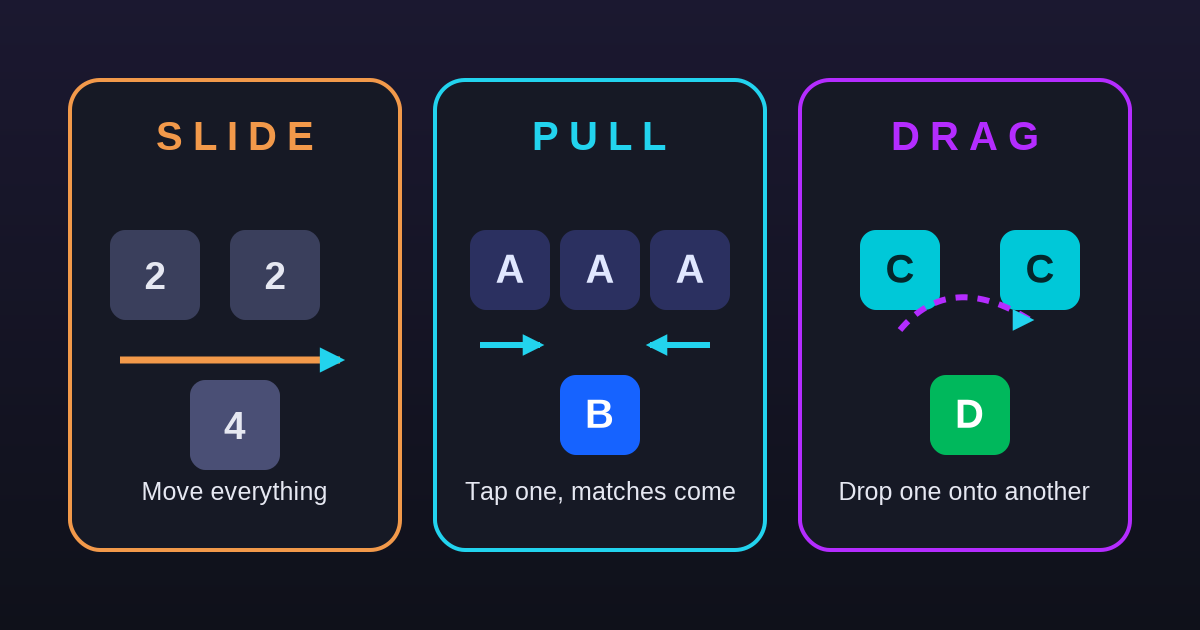
Sliding number puzzles. The closest relatives. Threes! is the original: you slide the whole board and combine 1s and 2s into 3s, then matching multiples of three. It's slower and more deliberate than 2048, with a gentler pace and plenty of charm.
Match-and-build games. In Triple Town by Spry Fox, you place items on a grid, and three of a kind combine into something bigger (grass into bushes into trees, and onward). It shares 2048's sense of building upward, with more strategy about placement.
Drop puzzles. In Drop7, you drop numbered discs into a grid, and a disc disappears when its number matches the length of its row or column. It's a different rule set but the same addictive mix of numbers, space and chain reactions.
Letter merge puzzles. Games like PULL keep the doubling ladder but use letters (A, B, C, … Z) and change how you move. Instead of sliding the whole board, you tap one tile and its matches come to it, so you decide exactly which tile grows and where.
Drag-to-merge games. You pick up one piece and drop it onto a matching one. Many collection-style mobile games, such as Merge Dragons, work this way, often with a world to decorate as you go.
Daily puzzles. Many puzzle fans like a fixed daily challenge alongside an endless mode: the same board for everyone, so there's something to share and compare.
Which kind should you try next?
| If you like… | Try… |
|---|---|
| Fast, sweeping moves | Sliding puzzles like 2048 and Threes! |
| Precise control and planning | Pull-merge games like PULL |
| Collecting and decorating | Drag-to-merge games with a world to build |
| A short challenge each day | A game with a daily puzzle, like Daily PULL |
| Letters rather than numbers | PULL, where you climb from A to Z |
How does PULL compare to 2048?
PULL is a magnet merge puzzle: tap a letter and every matching letter in its row and column slides toward it. Here's how it differs:
| 2048 | PULL | |
|---|---|---|
| Board | 4×4 | 5×5 |
| Your move | Swipe; every tile slides | Tap one letter; its matches slide to it |
| Merging | Pairs of equal numbers | Pairs of equal letters, A + A → B |
| Combos | Several pairs can merge in one swipe | Four in a line jump two letters at once (a cascade); matches from both directions make a super combo |
| New tile | Mostly a 2, sometimes a 4, in a random empty spot | An A or a B, in a spot shown on the board before you move |
| Goal | Reach the 2048 tile | Daily: reach E in 12 taps. Endless: climb as far toward Z as you can |
| Sessions | One long game | A short daily puzzle plus an endless mode |
The biggest difference is control. In 2048 every swipe moves the whole board. In PULL you choose exactly which tile acts, so you can plan precise merges, and because you can see where the next tile will land, there's less luck involved.
Which 2048 skills carry over?
Good 2048 habits translate well to other merge puzzles:
- Keep your biggest tile in a corner or along an edge, out of the way of new tiles.
- Protect empty space. A full board is a lost game. Merges that free up squares are worth more than they look.
- Don't move at random. Every move should either merge something or set up a merge.
- Think two moves ahead. Before you act, picture where the new tile will appear.
- Build in order. Keep tiles arranged in a rough sequence so merges can chain.
For the full method, see our 2048 strategy guide. Our PULL strategy guide shows how the same ideas apply to tapping and pulling instead of swiping.
Key takeaways
- 2048 (2014) is a sliding merge puzzle that drew on 1024 and Threes!.
- Merge games combine matching pieces into better ones; match-3 games clear them instead.
- There are three main ways to merge: slide, pull and drag.
- Its appeal comes from a doubling ladder, shrinking space and chain reactions.
- Similar games include number sliders, match-and-build games, drop puzzles and letter merge puzzles.
- PULL keeps the doubling ladder but gives you precise control: tap one letter and its matches come to it.
Frequently asked questions
What is the game 2048?
2048 is a free sliding-tile puzzle on a 4×4 grid. You swipe to move all the tiles, equal numbers merge into their sum, and the goal is to make a tile worth 2048 before the board fills up.
Who created 2048?
2048 was made by Italian developer Gabriele Cirulli and released in March 2014. Its credits say it was based on the game 1024 and conceptually similar to Threes! by Asher Vollmer and Greg Wohlwend.
Is there a game like 2048 with letters?
Yes. PULL is a merge puzzle that uses letters instead of numbers: two A's make a B, two B's make a C, and so on up to Z. Instead of swiping, you tap a letter and its matches slide to it.
What is a merge game?
A merge game is a puzzle where identical pieces combine into one higher-level piece, such as two 2s making a 4 in 2048, or two A's making a B in PULL.
What is the difference between merge and match-3 games?
In match-3 games, lining up matching pieces clears them from the board. In merge games, matching pieces combine into a better piece, so you build upward rather than clearing.
What is the best strategy for 2048?
Keep your highest tile in a corner, build the next tiles in order along one edge, avoid moves that pull your big tile out of its corner, and always protect empty space.
What are some good games like 2048?
Threes! is the closest relative. Triple Town and Drop7 share its build-up-and-manage-space feel, and PULL offers a letter-based twist with a daily puzzle.