Quick answer: Keep your biggest tile in one corner and never let it leave. Build the next-biggest tiles beside it in descending order along one edge, then snake back along the next row. Use mostly two directions (for example left and up), use a third only when it's safe, and almost never use the fourth. Protect empty squares above all else.
2048 looks like a game of luck the first time you play. It isn't. With one simple system, most players go from stalling at 256 or 512 to making 2048 regularly. Here's that system, step by step.
How does 2048 work?
You slide every tile on a 4×4 board up, down, left or right. Two tiles with the same number merge into their sum (2 + 2 = 4, 4 + 4 = 8, and so on). After every move, a new tile appears in a random empty square, usually a 2 and occasionally a 4. You lose when the board is full and no move can merge anything.
Reaching 2048 takes 1,024 twos' worth of merging, so it's a long game. What decides it is whether your tiles stay organised.
What is the corner strategy in 2048?
Choose one corner and keep your biggest tile there for the whole game. Most players pick a bottom or top corner; it doesn't matter which, as long as you stick with it.
Why it works: new tiles appear in random empty squares. If your big tile sits in a corner, small new tiles can't land on both sides of it and trap it. It also gives you a fixed place to build towards.
To keep the big tile in its corner, limit your directions. If your corner is the top left:
- Use left and up for most moves. Both push tiles toward your corner.
- Use right only when the top row is completely full, so the top row can't shift.
- Avoid down whenever you can. It pulls your big tile out of the corner and lets a 2 drop in behind it.
What is the snake pattern?
Once your biggest tile is in the corner, build a descending chain next to it: the second-biggest tile beside it, then the third, along the top row. When the row is full, the chain turns and runs back along the second row in the opposite direction, like a snake.
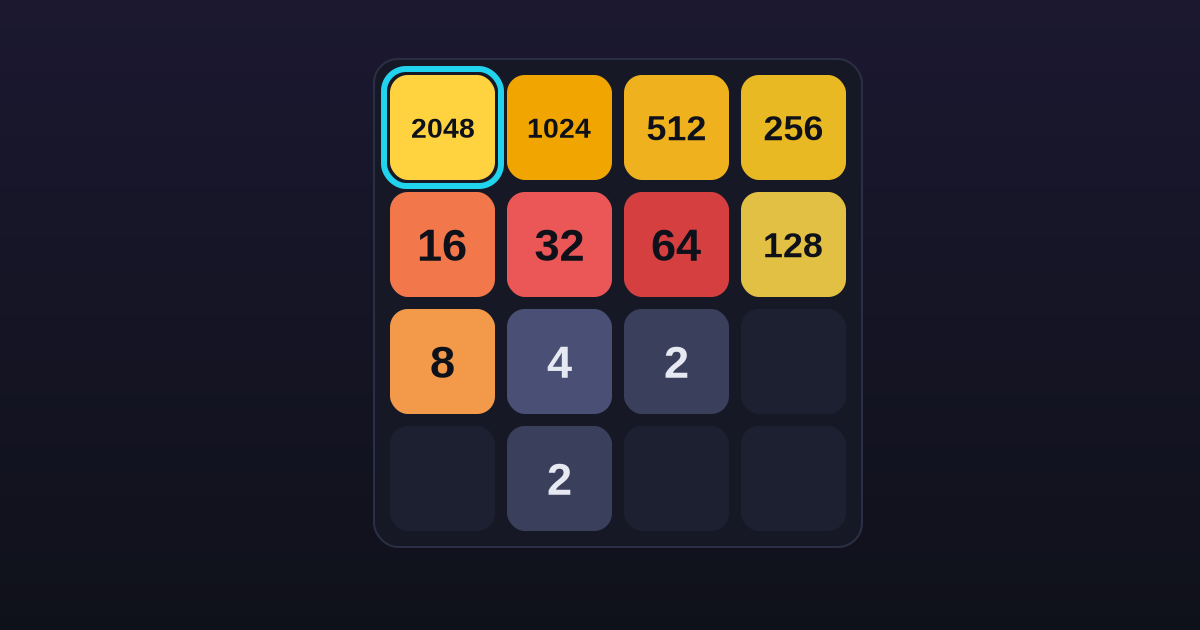
The point of the snake is that merges cascade. When the small end of the snake merges, it becomes equal to its neighbour and can merge again, and again, all the way back to the corner.
What moves should you avoid in 2048?
- The "emergency" fourth direction. Use it only when nothing else is possible, and fix the damage at once.
- Merging just because you can. A merge that pulls a tile out of your snake can cost you more than it gains.
- Building in two places. Two separate 128s in opposite corners are very hard to bring together.
- Fast swiping. There's no timer. Look at the board before every move.
How do you recover when the board is nearly full?
- Count your empty squares. If you have two or fewer, every move should create space.
- Look for the smallest merges first. Pairs of 2s and 4s are your breathing room.
- Work toward your snake, not away from it. Merge small tiles near the end of the snake so they can feed into it.
- If your big tile does leave the corner, move it back as soon as possible before a 2 takes its place.
Is 2048 luck or skill?
Both, but mostly skill. Where new tiles appear is random, and an unlucky 4 can spoil a plan. But players who use the corner and snake strategies win far more often than players who don't. On the standard 4×4 board, the theoretical highest tile is 131,072, so there's always further to go after 2048.
Do these strategies work in other merge games?
The core ideas carry over to almost every merge puzzle: keep big tiles out of the way, build in order, protect empty space and plan a move ahead. In PULL, a letter merge puzzle, you tap a single tile instead of sliding the whole board, so you can be even more precise, and the board shows where the next tile will land. Our PULL strategy guide shows how the same thinking applies, and games like 2048 looks at what to play next.
Key takeaways
- Keep your biggest tile in one corner all game.
- Use two main directions, a third only when safe, and avoid the fourth.
- Build a descending snake so merges cascade back to the corner.
- Protect empty squares. When space runs low, make small merges first.
- Slow down: there's no timer.
Frequently asked questions
What is the best strategy for 2048?
Keep your highest tile in one corner, build a descending row of tiles beside it in a snake pattern, use mostly two swipe directions, and avoid the direction that pulls your big tile out of its corner.
How long does it take to reach 2048?
A winning game usually takes around a thousand moves or more, since the 2048 tile is made from 1,024 twos' worth of merges. With practice, that's often 15 to 30 minutes of steady play.
Why do I keep getting stuck at 512 or 1024?
Usually because the biggest tile has drifted out of its corner, or tiles are built in two separate places. Keep one corner, one snake, and protect your empty squares.
Can you go higher than 2048?
Yes. Most versions let you keep playing after 2048. The theoretical highest tile on a 4×4 board is 131,072.
What are good games to play after 2048?
Other merge puzzles: Threes!, which inspired 2048, and letter merge puzzles like PULL, which add combos and a daily challenge.