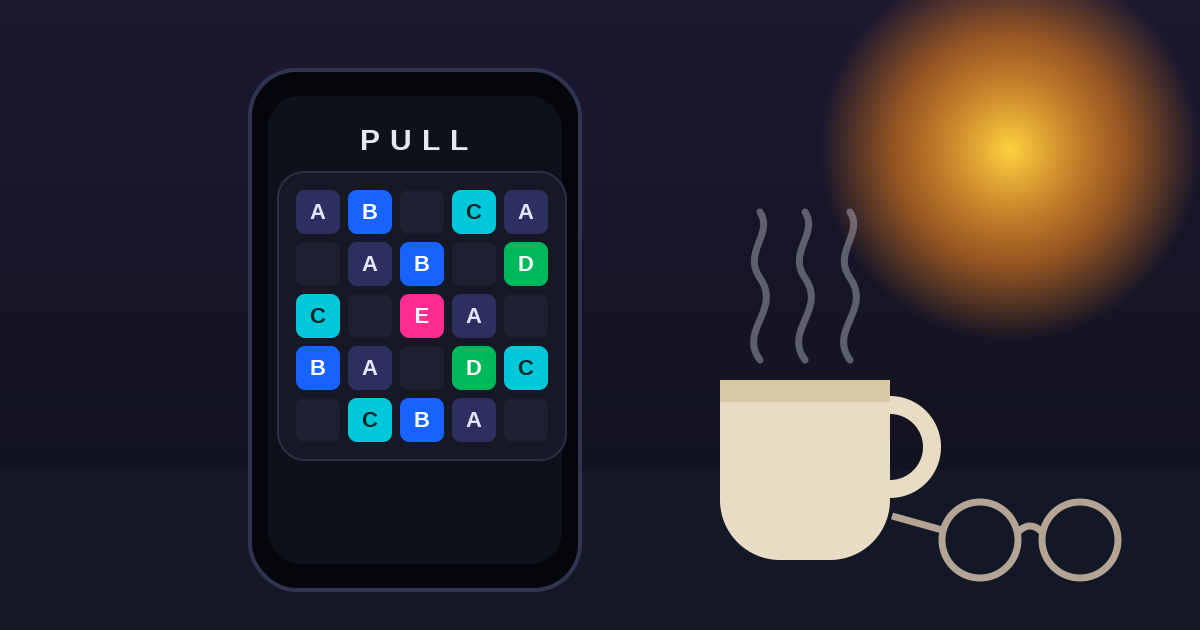
Quick answer: A short daily puzzle is a pleasant, low-cost way to keep your mind busy, focused and entertained. Research shows puzzle practice reliably makes you better at the puzzle; for wider brain health, the strongest evidence points to exercise, good sleep, social contact and lifelong learning. The best approach is to enjoy puzzles as one part of an active life, not as a cure-all.
If you're over 40 and you've found yourself reaching for a crossword, a sudoku or a game like 2048 with your morning coffee, you're in good company. Puzzle games are some of the most played games in the world, and adults in midlife and beyond make up a big share of their players. This guide looks at what puzzles really do for you, what to look for in a good one, and how to make a few minutes of play a habit worth keeping.
Why do so many adults over 40 love puzzle games?
Puzzles fit the shape of a busy adult life. They're short, they ask for focus rather than fast reflexes, and they end with a clear result: solved or not, a new best or a near miss.
- They reward thinking, not twitch speed. Most puzzle games let you take your time, so experience and patience count for more than reaction time.
- They're a real break. Ten minutes of absorbed focus is a reset from screens full of email and news.
- They give a small, reliable win. Finishing a puzzle is satisfying in a way many everyday tasks aren't.
- They're social. Daily puzzles that everyone plays at once give friends and families something to compare and talk about.
What does the science say about brain games?
This is where it pays to be careful, because "brain training" has been oversold.
Practice makes you better at what you practise. Study after study finds that people who train on a task get better at that task, and often at very similar tasks. Someone who plays a lot of number puzzles gets quicker at spotting number patterns.
Benefits rarely spread to everything else. The bigger promise, that a game will sharpen your memory in daily life or prevent decline with age, is much less certain. In 2014, a group of around 70 scientists brought together by the Stanford Center on Longevity and the Max Planck Institute for Human Development published a consensus statement warning that claims made for commercial brain games went well beyond the evidence. Two years later, the US Federal Trade Commission settled with a well-known brain-training company over advertising claims it said weren't backed up.
Some training effects can last. Large, long-running studies of older adults, such as the US ACTIVE trial, found that gains from structured cognitive training could last for years in the skills that were trained. Researchers still debate how much this carries over to everyday life.
Lifestyle matters most. The Lancet Commission on dementia prevention, an international panel of experts, has repeatedly found that a large share of dementia risk is linked to things we can influence over a lifetime: staying physically active, treating hearing loss, managing blood pressure, not smoking, keeping socially connected and continuing to learn.
So the honest summary is this: play puzzles because they're enjoyable and engaging, and pair them with the habits that have the strongest evidence. A puzzle with friends after a walk beats a puzzle alone on the sofa.
This article is general information, not medical advice. If you're worried about your memory, talk to your doctor.
What makes a puzzle game good for adults?
Not every puzzle game is worth your time. These are the qualities that make one a pleasure rather than a chore:
| What to look for | Why it matters |
|---|---|
| Large, high-contrast tiles and text | Easy on the eyes, especially on a phone and without reading glasses |
| A day and night mode | Comfortable in bright daylight and in bed at night |
| No timer pressure | You can think rather than rush |
| Short sessions with a clear goal | A satisfying finish in five to ten minutes |
| Fair rules you can learn in a minute | Depth comes from strategy, not from fiddly controls |
| No sign-up or personal data | Start playing straight away, privately |
| A daily puzzle | A gentle reason to come back, and something to share |
Be wary of games that push constant pop-ups, nag you to buy, or promise medical benefits. A good puzzle doesn't need to oversell itself. For the phone settings that make any game easier to see and play, see our guide to puzzle games for seniors and older adults.
How do you build a five-minute daily puzzle habit?
Habits stick when they're small and tied to something you already do. Habit researchers often describe a simple loop: a cue, a routine and a reward.
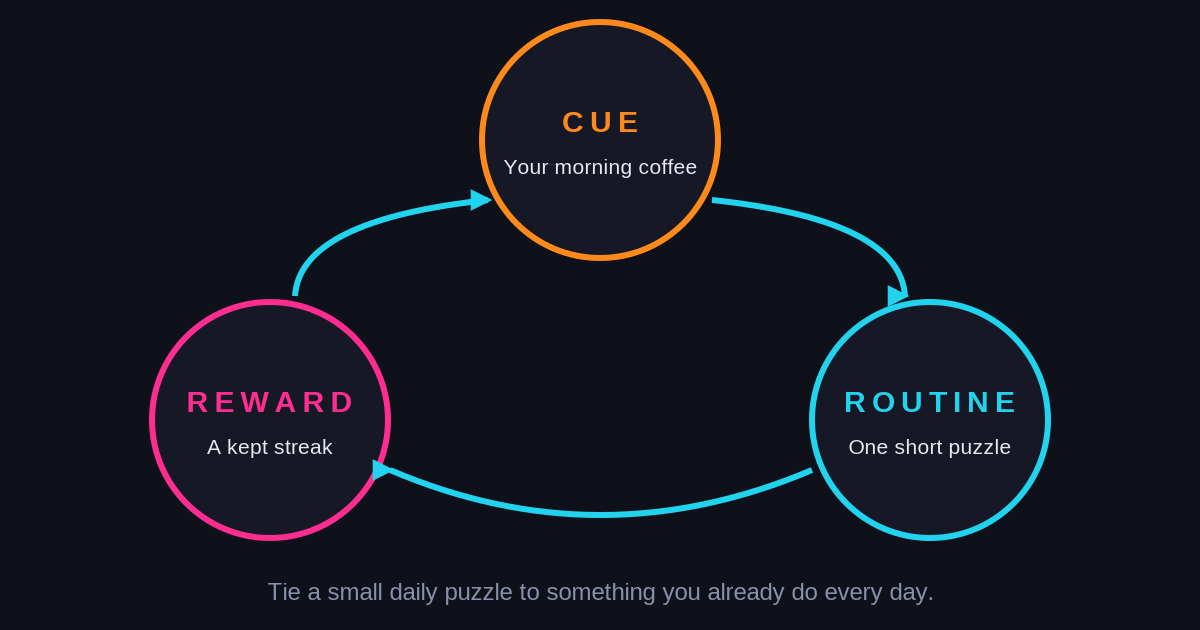
- Pick a cue you already have. Your first coffee, the train home, or the ten minutes before bed.
- Keep the routine tiny. One daily puzzle. That's it. Small goals are easy to keep on busy days.
- Notice the reward. A solved puzzle, a growing streak, or a result to send to a friend.
- Go easy on yourself. Missing a day isn't failure. Streaks are a nudge, not a judge.
- Make it social. Share your result with a partner, a sibling or a group chat. Comparing notes on the same daily puzzle turns a solo moment into a shared one.
Should you mix different kinds of puzzles?
Yes, if you enjoy it. Variety keeps things fresh and exercises different kinds of thinking:
- Word puzzles (crosswords, word searches) lean on vocabulary and memory.
- Number and logic puzzles (sudoku, nonograms) are about deduction and patterns.
- Merge puzzles (2048 and its descendants) are about planning ahead and managing space.
- Spatial puzzles (jigsaws, tangrams) work on shapes and visualising.
There's no single "best" type. The best puzzle is one you'll happily come back to.
Where does PULL fit in?
PULL is a free merge puzzle made with these ideas in mind. You tap a letter, and every matching letter in its row and column slides toward it like a magnet. Two A's make a B, two B's make a C, and so on up the alphabet to Z.
- Daily PULL gives everyone the same board each day. Reach the letter E in 12 taps or fewer to keep your streak, then share your result.
- Endless has no tap limit. Play at your own pace and chase a personal best.
- Big letter tiles, day and night modes, no timers and no sign-up. It runs in your browser and can be added to your home screen.
If you've enjoyed 2048, our guide to games like 2048 explains how PULL compares, and the PULL strategy guide covers the rules and the best tactics.
Key takeaways
- Puzzles make you better at puzzles; they're not a medical treatment.
- For brain health, exercise, sleep, hearing care and social contact have the strongest evidence. Puzzles are a great companion to them.
- Choose games that are readable, unhurried, fair and private.
- A five-minute daily puzzle tied to an existing routine is easy to keep.
- Sharing a daily puzzle with friends or family adds a social side that's good in its own right.
Frequently asked questions
Are puzzle games good for your brain after 40?
Puzzle games keep your mind engaged and reliably improve the skills they use, like spotting patterns and planning ahead. Evidence that they protect against age-related decline on their own is limited, so they work best alongside exercise, good sleep and social activity.
Are brain-training apps worth paying for?
Scientists have cautioned that many brain-training products claim more than the evidence supports. If a game is fun and you play it often, it's worth it as entertainment. Be sceptical of any game that promises medical benefits.
How long should I play puzzle games each day?
There's no magic number. Five to fifteen minutes a day is easy to keep up and long enough to be absorbing. Consistency and enjoyment matter more than duration.
Which is better for adults, word puzzles or number puzzles?
Neither is better overall. Word puzzles lean on vocabulary and memory, while number and merge puzzles lean on logic and planning. Mixing different types keeps puzzles fresh.
Is PULL free to play?
Yes. PULL is free to play in your browser with no sign-up. The Daily puzzle and Endless mode are both free.